HBM vs. GDDR: The Memory Architecture Showdown Quietly Deciding Your AI Cluster's Fate
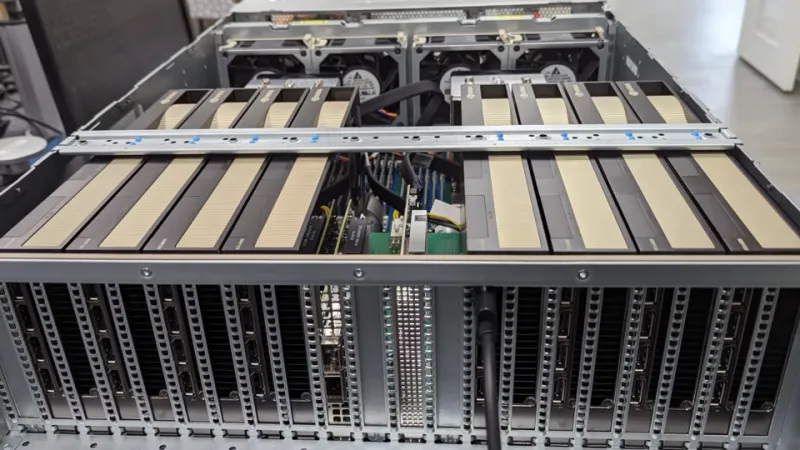
Photo: Lawrence Systems, CC BY 3.0, via Wikimedia Commons
For most of the past decade, GPU procurement conversations in enterprise IT revolved around a single question: how many CUDA cores, and at what clock speed? That framing made sense when training modest neural networks or accelerating rendering pipelines. It no longer does. As organizations scale large language models, recommendation engines, and multimodal inference workloads, a different constraint has moved to center stage—one that does not appear prominently in any vendor's marketing one-pager.
The memory wall is real, and it is costing US enterprises measurable throughput, energy, and budget.
What the Memory Wall Actually Means in Production
The term "memory wall" describes the growing imbalance between a processor's theoretical compute throughput and the rate at which it can move data in and out of memory. Modern AI accelerators can perform trillions of floating-point operations per second, yet a significant portion of that capacity sits idle whenever the memory subsystem cannot supply operands fast enough.
In practice, this manifests as low GPU utilization metrics despite hardware running at full power draw. An H100 SXM5 reporting 35 percent SM utilization during a transformer inference run is not a cooling problem or a driver issue—it is a memory-bound workload. The chip is waiting. Every millisecond it waits represents compute capacity the organization paid for and is not receiving.
The ratio that matters here is arithmetic intensity: the number of floating-point operations performed per byte of memory traffic. Workloads with low arithmetic intensity—autoregressive token generation being the canonical example—are almost always memory-bandwidth-limited, regardless of how many petaFLOPS sit on the die.
Diagnosing the Problem Before Buying More Hardware
Before any procurement conversation begins, IT teams should instrument their existing deployments. NVIDIA's Nsight Systems and Nsight Compute profilers expose memory throughput utilization as a percentage of theoretical peak bandwidth. AMD's ROCm profiling stack offers equivalent visibility through its rocprof toolchain. Any sustained memory bandwidth utilization above 80 to 85 percent should be treated as a warning sign that the workload has outgrown the card's memory architecture.
Beyond profiler data, three operational signals reliably indicate memory saturation:
- Batch size sensitivity: If doubling the inference batch size produces less than a proportional throughput gain, the memory bus is likely the constraint.
- Precision-insensitive latency: Switching from FP16 to INT8 quantization should reduce memory traffic and improve throughput. If the improvement is marginal, suspect memory bandwidth saturation rather than compute bottleneck.
- Stalled copy engines: High CUDA memcpy stall rates in profiler traces indicate that data movement between host and device—or between VRAM and L2 cache—is serializing execution.
These diagnostics cost nothing beyond engineering time, and they frequently reveal that organizations are hardware-constrained in ways additional raw compute will not resolve.
Architecture Comparison: H100, H200, and the MI300X
With a clear diagnostic picture in hand, procurement teams can evaluate current-generation accelerators against actual workload requirements rather than peak FLOP ratings.
NVIDIA H100 SXM5 remains the most widely deployed data center GPU in US enterprise environments. Its HBM2e memory subsystem delivers approximately 3.35 terabytes per second of bandwidth across 80 GB of capacity. For moderately memory-intensive workloads, it remains capable. However, organizations running large-context LLM inference—particularly models exceeding 70 billion parameters—will encounter bandwidth saturation regularly.
NVIDIA H200 SXM5 addresses this directly. By transitioning to HBM3e memory, NVIDIA increased bandwidth to roughly 4.8 terabytes per second while expanding capacity to 141 GB. For memory-bound inference workloads, this represents a meaningful architectural improvement—not a marginal one. The H200 does not dramatically increase compute throughput relative to the H100; its value proposition is almost entirely about feeding the compute units data at a higher rate. IT teams whose profiler data shows memory-bound workloads should weight this distinction heavily.
AMD MI300X takes a different structural approach. By integrating CPU and GPU dies into a unified chiplet design with 192 GB of HBM3 memory and approximately 5.3 terabytes per second of bandwidth, AMD has produced a card with the highest memory capacity and competitive bandwidth among commercially available accelerators. For organizations managing extremely large model weights—particularly those attempting to run 180-billion-parameter or larger models on a single node—the MI300X's capacity advantage is operationally significant. The tradeoff lies in software ecosystem maturity: ROCm's tooling depth and third-party framework support still trails CUDA in US enterprise deployments, a gap that carries real operational cost.
Making the Procurement Decision That Matches Your Workload
The appropriate accelerator selection depends on which constraint is actually binding. IT teams should resist the instinct to default to the most recently released product or the highest aggregate FLOP rating.
For training-dominant workloads with high arithmetic intensity—convolutional networks, dense transformer pre-training—compute throughput remains the primary driver. The H100 continues to perform competitively here, and its mature software ecosystem reduces integration friction.
For inference-dominant workloads with large context windows or high concurrency requirements, memory bandwidth and capacity are the governing variables. The H200 offers the most straightforward migration path for NVIDIA shops, while the MI300X warrants serious evaluation for organizations willing to invest in ROCm tooling.
For mixed-use clusters serving both training and inference, disaggregating the two workload types onto separate hardware pools—rather than provisioning a single accelerator type for both—frequently yields better utilization and lower total cost per query.
Beyond the Spec Sheet
The most consequential procurement mistakes in AI infrastructure consistently share a common origin: teams evaluating accelerators on peak theoretical metrics rather than workload-matched empirical benchmarks. A GPU with 20 percent lower peak FLOPS but 40 percent higher memory bandwidth will outperform a nominally faster chip on memory-bound inference tasks. That outcome will not be visible on any vendor comparison table.
IT organizations investing in AI infrastructure should establish internal benchmarking protocols using representative production workloads before finalizing hardware decisions. Cloud-based spot instances for H100, H200, and MI300X configurations are widely available through AWS, Azure, and Google Cloud, enabling direct comparison at a fraction of the cost of a procurement error at scale.
The memory wall is not a temporary inconvenience pending the next FLOP-count generation. It is a structural feature of how AI workloads consume data. Organizations that instrument their pipelines, understand their arithmetic intensity profiles, and select hardware accordingly will extract materially more value from their infrastructure budgets than those that do not.